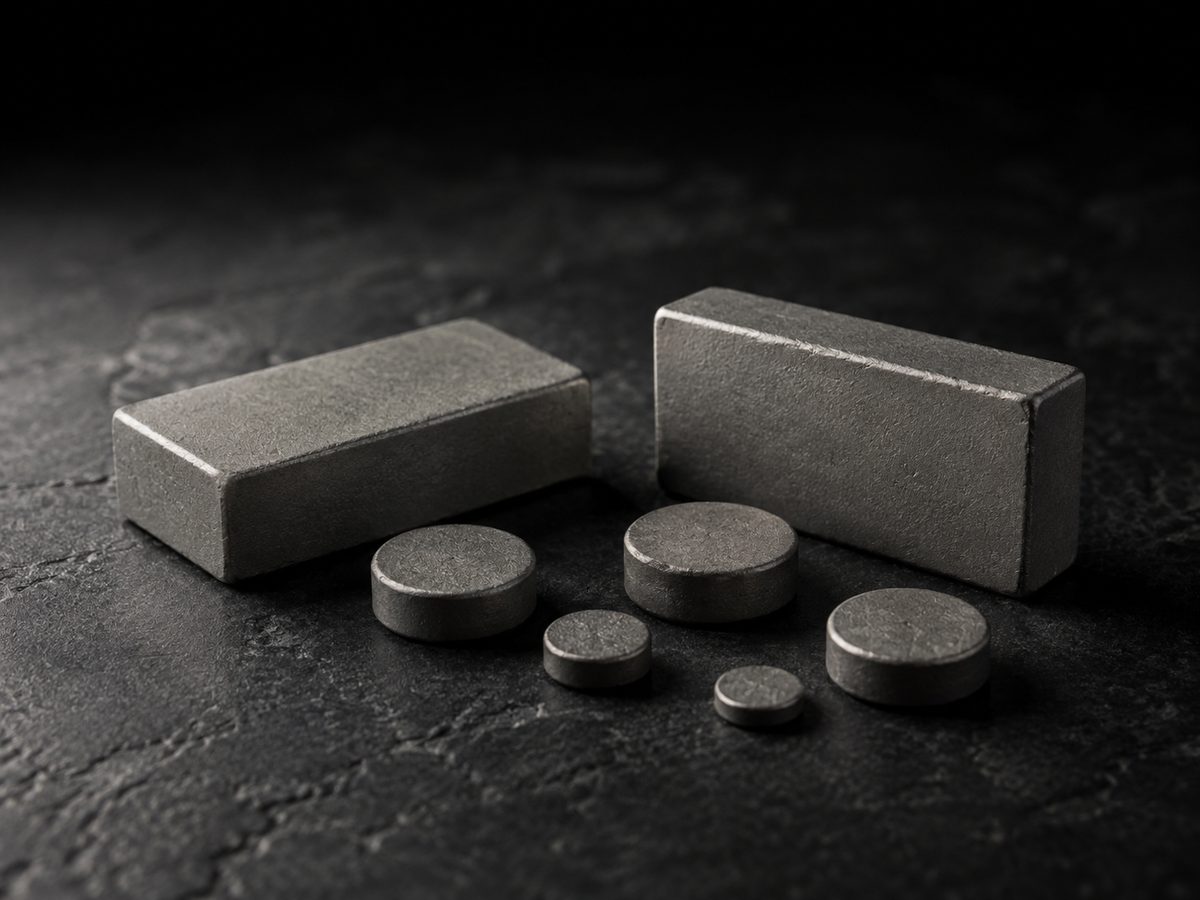
samarium cobalt
SmCo Magnets
SmCo: when NdFeB runs out of temperature
Sintered samarium cobalt comes in two families: Sm1Co5 (1:5) and Sm2Co17 (2:17). Both give up energy product against NdFeB - 2:17 by roughly 30%, 1:5 by more than half - in exchange for a reversible temperature coefficient of induction of -0.030 to -0.035%/degC (2:17) or -0.04 to -0.045%/degC (1:5), continuous operation to 250-350degC, and intrinsic corrosion resistance that usually removes the need for a coating. Choose SmCo when the magnet must hold flux stably over a wide thermal range, sit in a corrosive or vacuum environment, or survive decades without a plating layer to fail - not when you are chasing maximum energy density or a low unit price.
Request a quoteSpecification
- Alloy families
- Sm1Co5 (1:5, YX/XG-16/18/20 class) and Sm2Co17 (2:17, YXG-24/26/28/30/32 class)
- Grade range
- SmCo16-SmCo20 (1:5); SmCo24, SmCo26, SmCo28, SmCo30, SmCo32 (2:17)
- BHmax
- 16-20 MGOe (127-159 kJ/m3) for 1:5; 24-32 MGOe (191-255 kJ/m3) for 2:17. SmCo32 sits at the practical ceiling of production sintering
- Remanence (Br)
- 0.82-0.95 T (1:5); 1.00-1.15 T (2:17)
- Intrinsic coercivity (Hcj)
- 1195-2000 kA/m (15-25 kOe) typical; 1:5 can reach >2400 kA/m (30 kOe) in low-Br grades
- Max operating temperature
- 250degC standard for both 1:5 and 2:17; 300degC and 350degC 2:17 variants available at reduced Br. Curie point ~800-850degC (2:17), ~720-750degC (1:5). Max service temp is load-line dependent - a Pc of 2 or better is assumed
- Temperature coefficients
- Br: -0.030 to -0.035%/degC (2:17), -0.04 to -0.045%/degC (1:5). Hcj: -0.2 to -0.3%/degC, with 1:5 toward the steep end. NdFeB is roughly -0.11 to -0.12%/degC Br for comparison
- Tolerance and coatings
- As-sintered +/-0.1 mm typical; ground +/-0.05 mm, +/-0.02 mm achievable on critical faces. Normally supplied bare (passive oxide is stable to ~300degC in air). Ni, Ni-Cu-Ni, epoxy or parylene only where particulate containment or bonding demands it
Typical applications
- Aerospace and defence actuators, sensors and travelling-wave tube focusing structures, where flux drift over -55 to +200degC must stay within a fraction of a percent
- High-speed and high-temperature PM motors and generators - turbochargers, aircraft engine accessories, downhole tooling
- Precision instrumentation: Hall-effect and magnetoresistive sensors, flowmeters, load cells, where the temperature coefficient dominates the error budget
- Magnetic couplings and pumps handling hot or aggressive fluids, where an NdFeB coating failure would liberate corrosion product into the process
- Vacuum and UHV assemblies - ion pumps, mass spectrometers, particle beam optics - where low outgassing and no plating are mandatory
- Oil and gas MWD/LWD tooling operating continuously at 200degC+ with thermal cycling
Engineering notes
- Cost is the main barrier. Cobalt dominates the bill of materials - roughly 66 wt% of a 1:5 alloy and about 50 wt% of a 2:17 (the balance including 15-20% Fe, 5-6% Cu and 2-3% Zr) - and samarium carries its own supply dynamics. Expect SmCo to run several times the price per kilogram of an equivalent NdFeB part, and the gap widens on a per-MGOe basis. If your worst-case hot-spot is 150degC or below, a high-Hcj NdFeB grade will almost always be the cheaper correct answer.
- It is brittle and weak in tension - roughly 35 MPa tensile, 800 MPa compressive, fracture toughness around 1 MPa*m^0.5, with 2:17 more prone to chipping than 1:5. Thin sections, sharp internal corners, blind threads and unsupported spans are asking for cracks. Keep minimum wall above ~1.5 mm, chamfer all edges, and never treat the magnet as a structural member. Handling and press-fit assembly cause more field failures than the magnetics ever do.
- 2:17 alloys need a controlled solution-treat plus isothermal ageing cycle to develop the cellular precipitate structure that carries the coercivity. Properties are therefore sensitive to section thickness and process discipline, and grade-to-grade Hcj scatter is wider than in NdFeB. Specify Hcj at your actual operating temperature, not just at 20degC, and ask for a demagnetisation curve at temperature.
- Corrosion resistance is good, not universal. The oxide passivates in air and most neutral environments, but SmCo is attacked by strong acids, oxidises measurably above ~350degC in prolonged exposure, and is not immune to hydrogen - avoid pressurised hydrogen service. Uncoated parts also shed fine dark particles under abrasion, which matters in clean optical or bearing assemblies.
- Shaping is abrasive and electrical, not chip-forming: diamond wheel grinding with coolant, plus wire or sinker EDM for slots, holes and profiles (SmCo is conductive). No turning, drilling or tapping - so tolerance and shape complexity drive price more steeply than material volume does. Saturation also demands a higher applied field than NdFeB: plan for roughly 2400-3200 kA/m (30-40 kOe) for 2:17 and 3200-4000 kA/m (40-50 kOe) for 1:5, which is the hardest commercial magnet family to saturate. Magnetising fixtures sized for NdFeB leave SmCo partially magnetised, which shows up as a quiet 5-10% flux shortfall rather than an obvious failure.
Answers
SmCo Magnets FAQ
SmCo 1:5 or 2:17 - how do I choose?
Default to 2:17 for energy product (24-32 MGOe versus 16-20), better temperature coefficient and higher usable temperature. Choose 1:5 when you need very high intrinsic coercivity in a thin or low-permeance geometry, when the part is small and fragile enough that 1:5's slightly better machinability and lower chipping tendency helps, or when resistance to an opposing demagnetising field matters more than raw flux. Note the trade-off: 1:5 is the harder of the two to saturate and needs a 40-50 kOe magnetising fixture, so confirm your magnetiser before committing.
Do I need a coating?
Usually not, and that is a large part of why SmCo is specified. The native oxide is stable in air and most industrial atmospheres, and omitting the plating removes the single most common long-term failure mode of an NdFeB assembly. Coat only for a specific reason: Ni or Ni-Cu-Ni to contain particulate in clean or bearing-adjacent environments, epoxy for an adhesion surface or dielectric isolation, parylene for conformal coverage on complex shapes. Any coating adds thickness that eats into your magnetic gap tolerance.
What do you need from me to quote?
Grade or, better, the magnetic requirement plus the actual operating temperature and load line (Pc) - we would rather size the grade than have a 20degC datasheet number handed to us. Then: drawing with tolerances called out per face, magnetisation direction and any multipole pattern, quantity and annual volume, whether the part ships magnetised or unmagnetised, coating if any, and whether you need per-batch demagnetisation curves at temperature or a first-article magnetic report. Flag any hydrogen, strong-acid or above-350degC exposure at RFQ stage rather than after tooling.
Next