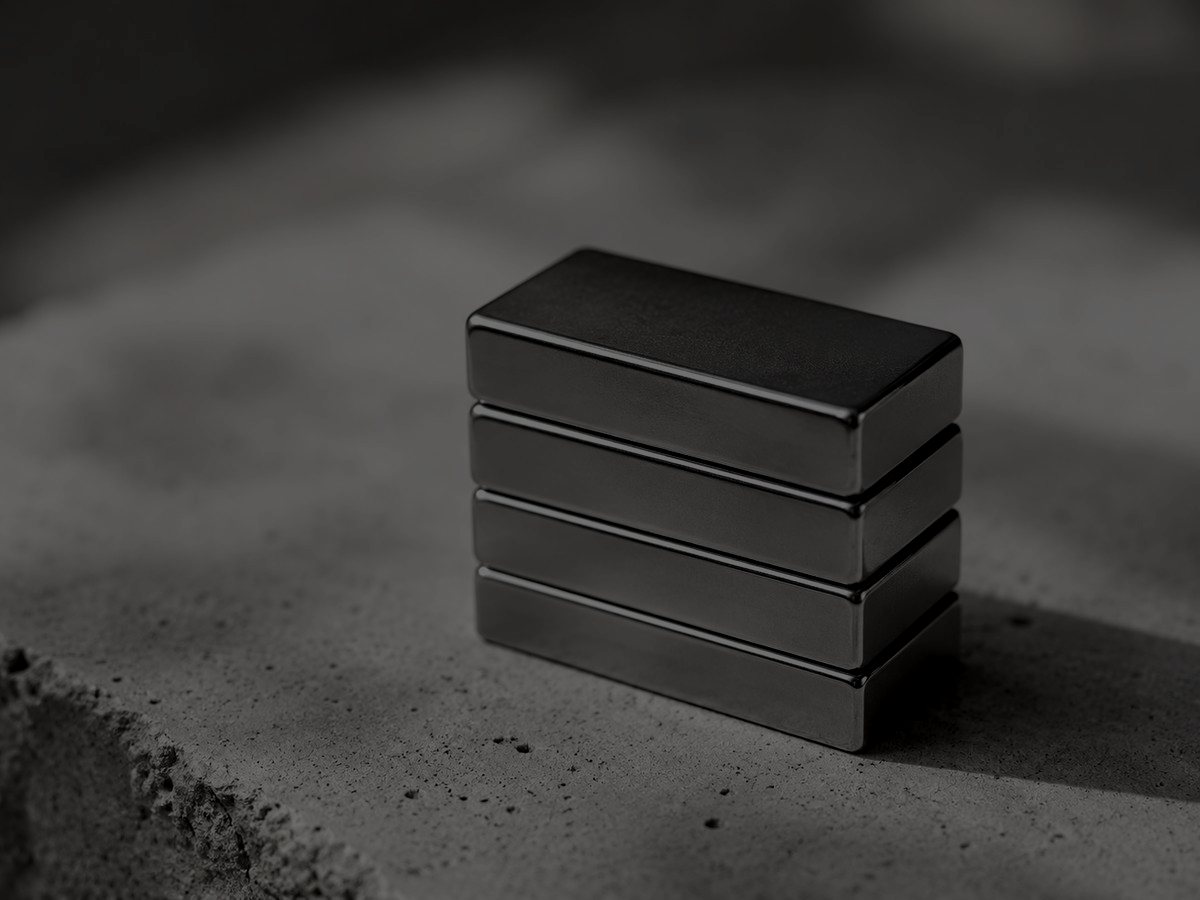
sintered NdFeB
Block Magnets
Sintered NdFeB blocks: the default rare-earth geometry
Rectangular sintered NdFeB blocks are the workhorse form for linear actuators, magnetic separators, holding fixtures and surface-mounted rotor segments — anywhere a defined pole face and predictable flux over a flat area matter more than rotational symmetry. Blocks are pressed and aligned in a field, sintered, then machined to size, so the magnetisation axis is fixed at press time while dimensions stay tightly controlled on all three axes. Choose a block over a disc or ring when your working gap is rectangular, when you need to tile several magnets into an array, or when you want to trade cross-section for length to shift the permeance coefficient.
Request a quoteSpecification
- Grade range
- N35–N52 standard; M, H, SH, UH, EH suffixes for elevated temperature (e.g. N42SH, N38UH, N35EH)
- BHmax
- 263–422 kJ/m³ (33–53 MGOe), grade dependent. N35 ≈ 263–287 kJ/m³ (33–36 MGOe); N42 ≈ 318–342 kJ/m³ (40–43 MGOe); N52 ≈ 398–422 kJ/m³ (50–53 MGOe)
- Remanence (Br) at 20 °C
- 1.17–1.22 T (N35) rising to 1.43–1.48 T (N52). Reversible temperature coefficient of Br −0.11 to −0.13 %/°C
- Intrinsic coercivity (Hcj)
- ≥955 kA/m (N, 12 kOe) · ≥1114 kA/m (M, 14 kOe) · ≥1353 kA/m (H, 17 kOe) · ≥1592 kA/m (SH, 20 kOe) · ≥1990 kA/m (UH, 25 kOe) · ≥2388 kA/m (EH, 30 kOe)
- Max operating temperature
- 80 °C (N) · 100 °C (M) · 120 °C (H) · 150 °C (SH) · 180 °C (UH) · 200 °C (EH). Guide values at a permeance coefficient near 2 — the real limit depends on geometry and applied field, not the suffix alone
- Dimensional tolerance
- ±0.1 mm typical on general machined dimensions; ±0.05 mm on precision-ground faces; ±0.02 mm on request with cost and lead-time impact. As-sintered (unmachined) ±2–5%
- Coatings
- NiCuNi 10–25 µm (default) · Zn 5–15 µm · epoxy 15–25 µm · NiCuNi+epoxy · Ni+Au · Parylene · phosphate passivation for potted assemblies only
- Size range and magnetisation
- ≈1 × 1 × 0.5 mm up to ≈150 × 100 × 50 mm single-piece; larger footprints tiled. Magnetised through thickness, length, width or on a diagonal — axis must be nominated on the drawing
Typical applications
- Linear motors and voice-coil actuators — blocks tiled along a magnet way, where flat pole faces and consistent piece-to-piece Br keep force ripple predictable
- Magnetic separators, drum and plate separators — block arrays behind a stainless face plate, typically N42 or N42H, pulling ferrous contamination from bulk material flow
- Surface-mounted rotor segments in servo, spindle and traction motors — flat blocks on low pole-count and prototype rotors; arc segments derive from the same sintered stock
- Holding, clamping and welding fixtures — blocks in a steel yoke, giving far higher holding force per unit volume than ferrite in the same envelope
- Sensor and encoder targets — small blocks under about 10 mm, magnetised through thickness to trigger Hall or reed devices at a defined switch point
- Magnetic couplings and eddy-current brakes — alternating-polarity blocks around a hub, usually SH or UH to cover rotor self-heating
Engineering notes
- Sintered NdFeB is a rare-earth alloy, not a ceramic. Ferrite (ceramic) blocks are a genuinely different product — roughly a third of the remanence and about a tenth of the energy product, but better corrosion resistance, better cost and a positive intrinsic coercivity coefficient with temperature (ferrite demagnetises at low temperature, not high). If your application is cost-driven and space is not tight, ferrite may be the correct answer; do not reach for NdFeB by reflex. Be aware that some catalogue listings, including TT's own live block page, mislabel these blocks as ceramic — the data here is NdFeB.
- The per-grade temperature limits above assume a permeance coefficient around 2. A thin block magnetised through its short axis sits at a low working point and will show irreversible loss well below the quoted maximum, especially against an opposing coil field. Specify your geometry, ambient and applied field rather than a temperature alone, and expect to step up a grade (N42 → N42H) for thin sections. Separately, the reversible Br drift of about −0.12 %/°C bites in metrology and sensor work long before any permanent loss appears.
- Corrosion is the dominant field-failure mode. Bare NdFeB oxidises and eventually powders in humid or salt service, so the coating is part of the design life, not decoration. NiCuNi is the sensible default at roughly 24–72 h neutral salt spray; epoxy or NiCuNi+epoxy suits damp or chemically aggressive environments. No coating survives a chipped edge — specify a chamfer or radius on handled parts, and raise hydrogen-bearing or acidic environments before RFQ.
- The material is brittle and weak in tension — roughly 75–80 MPa tensile against about 1000–1100 MPa compressive, with fracture toughness near 2 MPa·m^0.5 — so it cracks under bending, impact and thermal shock. Blocks must be held in compression or bonded, and must never carry structural load. Sintered NdFeB is also electrically conductive, so segmentation may be needed to control eddy-current loss at high electrical frequency. Machining is done unmagnetised — no meaningful rework is possible after magnetisation.
- Grade inflation is common across the supply base, N52 especially, where stock often measures closer to N50. Ask for hysteresigraph data on the actual lot rather than a datasheet reprint, and put acceptance limits on Br and Hcj if the design has little margin. Heavy rare-earth content (Dy/Tb) drives H/SH/UH/EH pricing and is volatile; grain-boundary-diffusion grades can reach equivalent Hcj with less Dy and are worth asking about on cost-sensitive high-temperature parts.
Magnetic properties
Sintered NdFeB grade data
Measured at 20 °C. Every shipment leaves with a hysteresigraph report against these figures — ask for the lot data, not a datasheet reprint.
| Grade | Br (T) | Hcb (kA/m) | Hcj (kA/m) | BHmax (kJ/m³) | BHmax (MGOe) | Max op. temp. |
|---|---|---|---|---|---|---|
| N35 | 1.17–1.22 | ≥ 868 | ≥ 955 | 263–287 | 33–36 | 80 °C |
| N38 | 1.22–1.25 | ≥ 899 | ≥ 955 | 287–310 | 36–39 | 80 °C |
| N42 | 1.28–1.32 | ≥ 923 | ≥ 955 | 318–342 | 40–43 | 80 °C |
| N45 | 1.32–1.38 | ≥ 923 | ≥ 955 | 342–366 | 43–46 | 80 °C |
| N48 | 1.38–1.42 | ≥ 923 | ≥ 876 | 366–390 | 46–49 | 80 °C |
| N52 | 1.43–1.48 | ≥ 876 | ≥ 876 | 398–422 | 50–53 | 80 °C |
| N42M | 1.28–1.32 | ≥ 963 | ≥ 1114 | 318–342 | 40–43 | 100 °C |
| N42H | 1.28–1.32 | ≥ 963 | ≥ 1353 | 318–342 | 40–43 | 120 °C |
| N42SH | 1.28–1.32 | ≥ 979 | ≥ 1592 | 318–342 | 40–43 | 150 °C |
| N38UH | 1.22–1.25 | ≥ 923 | ≥ 1990 | 287–310 | 36–39 | 180 °C |
| N35EH | 1.17–1.22 | ≥ 876 | ≥ 2388 | 263–287 | 33–36 | 200 °C |
Read the suffix, not just the number. None / M / H / SH / UH / EH denote intrinsic coercivity class — higher classes hold their magnetism hotter, at the cost of remanence and heavy rare earth (Dy/Tb). Max operating temperatures assume a permeance coefficient near 2: a thin magnet, or one facing an opposing coil field, will lose output well below the figure quoted. Figures are typical production ranges, not guaranteed minima for every lot.
Answers
Block Magnets FAQ
Are these ceramic or ferrite magnets?
No. These are sintered NdFeB — a neodymium-iron-boron rare-earth alloy, pressed in an aligning field, sintered, machined and coated. Ceramic (ferrite) is a separate material class, a strontium or barium iron oxide with Br around 0.38–0.43 T and BHmax around 28–34 kJ/m³ (3.5–4.3 MGOe), against NdFeB's 1.17–1.48 T and 263–422 kJ/m³. The two are not interchangeable without redesigning the magnetic circuit. If you arrived here looking for ceramic blocks, ask for ferrite explicitly.
Which grade should I specify?
Work backwards from the operating point, not the headline number. Establish the working gap and permeance coefficient, then the worst-case magnet temperature under load, including any demagnetising field from coils. N42 or N45 covers most room-temperature holding, separation and sensing. Anything above roughly 80 °C at the magnet, or any thin section facing an opposing field, needs at least an H grade; underbonnet automotive and traction rotors typically land at SH or UH. Send geometry, temperature and applied field and it can be checked against the demagnetisation curve rather than guessed.
What should an RFQ include?
Dimensions with a tolerance on each axis; the magnetisation direction marked on a sketch (the single most common omission); grade or the performance you actually need; coating; sample and annual quantities; operating temperature and environment. If the block sits inside a steel circuit, a sketch of that circuit or the permeance coefficient is more useful than a grade name. Flag any pull-force, flux-density or gauss-map acceptance test up front — adding a test spec after tooling is committed costs both time and money.
Next