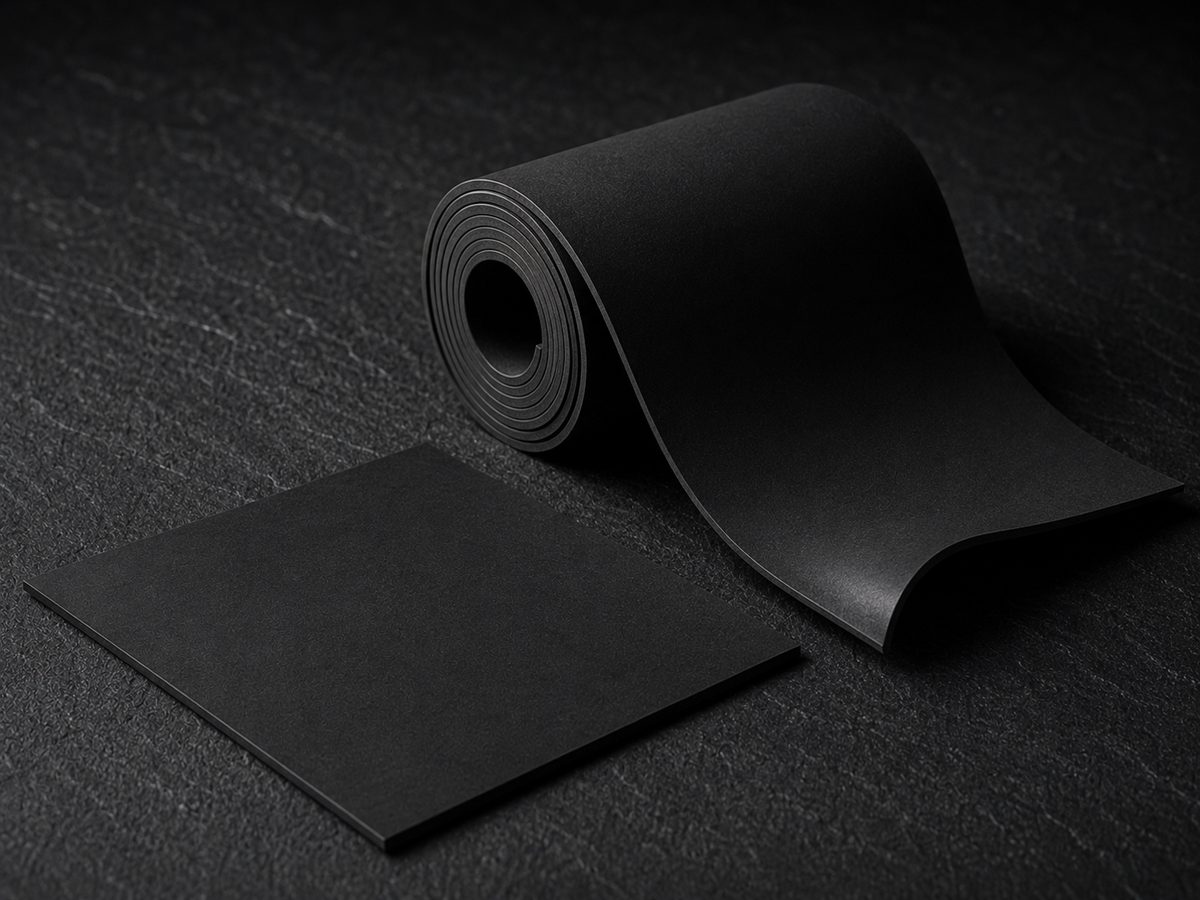
flexible bonded ferrite
Rubber / Flexible Magnets
Flexible ferrite strip where holding force is secondary
Flexible magnet is strontium (occasionally barium) ferrite powder (typically 60-70 vol%, ~85-90 wt%) loaded into a nitrile rubber (NBR), chlorinated polyethylene or PVC binder, then calendered or extruded and multipole-magnetised across one face. Energy product is roughly 0.6-1.6 MGOe — a factor of three to five below sintered ferrite and around 2-3% of N52 — so it is never the right choice when force per unit area matters. Choose it when you need a magnet that can be cut with scissors or a rotary die, wound onto a roll, laminated with vinyl or white PVC for printing, and conform to a curved or imperfect surface at very low cost per square metre.
Request a quoteSpecification
- Material / binder
- Sr- (occasionally Ba-) ferrite powder in NBR, CPE or PVC binder; ~85-90 wt% filler (~60-70 vol%), giving ~3.5-3.8 g/cm³
- Grade range (BHmax)
- 0.6-1.6 MGOe (4.8-12.7 kJ/m³); isotropic ~0.6-1.0, anisotropic ~1.2-1.6
- Br / Hcb
- Br 1,500-2,700 G (0.15-0.27 T) — isotropic ~1,500-1,800 G, anisotropic ~2,300-2,700 G; Hcb 1,300-2,400 Oe; Hcj 2,500-3,500 Oe
- Max operating temperature
- Binder-limited, not magnet-limited (ferrite Curie point is ~450 °C): ~80-100 °C continuous for NBR-bonded grades, ~70-80 °C for PVC-bonded and laminated stock. Excursions above this degrade the elastomer — plasticiser loss, stiffening, curl — before any magnetic loss occurs
- Magnetisation
- Multipole on one face; standard pole pitch 1.5-2.5 mm (typ. 2.0 mm). Single-pole/axial available at ~40-50% of the multipole surface pull in contact, but it reaches usefully further from the surface
- Standard sizes
- Thickness 0.4-6.0 mm (0.75, 1.0, 1.5, 2.0 mm most common). Roll width 10-1,220 mm (620 mm is the common stock width); roll length up to 30 m. Sheets typ. 620 × 1,000 mm
- Tolerance
- Thickness ±0.1 mm or ±5%, whichever is greater; slit width ±0.3 mm; die-cut profile ±0.5 mm; length ±1% on rolls. Do not expect machined-part tolerances
- Surface / coating options
- Plain black, brown or grey; white or coloured PVC lamination; PET film; UV/latex/solvent printable topcoat; acrylic or rubber PSA on the reverse. Note these are cosmetic and functional — ferrite needs no corrosion protection
Typical applications
- Refrigerator, cabinet and shower-door gaskets — profile-extruded flexible ferrite in a PVC or NBR seal carrier
- Printed vehicle door signage, whiteboard sheets and promotional magnets on laminated white PVC stock
- Die-cut components for point-of-sale, sample boards, planning charts and toy/education kits
- Reed and Hall-sensor actuation — but only with single-pole (axially magnetised) stock at sub-millimetre to ~1 mm gaps. Standard multipole stock is not a sensor magnet: its field is gone before it reaches the sensor
- Magnetic window insulation strip, insect-screen closures and darkroom/blackout seals
- Low-force retention of light panels, guards and covers on ferrous sheet metal where repeated repositioning is needed
Engineering notes
- Holding force is very low and drops off fast. Expect roughly 15-25 g/cm² for 1.5 mm multipole stock in direct contact with clean 1 mm mild steel. Every 0.1 mm of paint, powder coat or air gap costs a meaningful fraction of that — at 0.5 mm gap you may be down to a quarter of the contact value. The multipole pattern makes the field decay exponentially with distance: one magnetic wavelength spans an N+S pair, so the decay length is pole pitch / π — about 0.64 mm at the standard 2.0 mm pitch. Beyond ~2-3 mm there is essentially nothing left. If your design has a gap, this material is the wrong material.
- The multipole face is directional and unmarked to the eye. Two strips only attract each other properly when their pole lines are parallel and aligned; rotate one by 90° and they nearly cancel. It also means the strip has a strong face and a near-dead face — always confirm orientation and pole pitch in the RFQ if the part mates with an existing counter-strip (e.g. a legacy fridge gasket).
- The binder ages, not the ferrite. Plasticiser migration in PVC-bonded grades causes shrinkage, curl, staining of painted surfaces and stiffening over years, accelerated by UV and heat. NBR-bonded grades are more dimensionally stable and better for gaskets but cost more and are less receptive to lamination. Outdoors on a vehicle, expect visible degradation and lifting within 1-3 years unless a PET/UV-stable laminate is specified.
- Anisotropic grades reach ~1.6 MGOe because calendering aligns the ferrite platelets with their easy axis normal to the sheet plane — which is the through-thickness direction you actually magnetise and use. The caveat is that no such gain exists in-plane, and the price premium over isotropic is real. Isotropic stock at ~0.6-1.0 MGOe is often the honest choice — the difference in a printed sheet application is not worth the cost, whereas in a gasket it can be.
- Ferrite has a strongly negative Br temperature coefficient (≈ -0.2%/°C) and a positive Hcj coefficient — meaning coercivity falls as the material gets colder, which is the opposite of the intuition most engineers carry over from NdFeB. Below about -20 °C the coercivity falls enough that irreversible loss becomes possible if the strip is separated and re-applied cold. Cold-chain and freezer-door applications should be specified deliberately, not assumed.
Answers
Rubber / Flexible Magnets FAQ
Can flexible magnet replace a thin sintered ferrite or NdFeB disc to save cost?
Almost never on force. At ~1.0 MGOe it delivers roughly 2.5% of the energy product of a 40 MGOe NdFeB (2-4% across the flexible grade range) and about 25-30% of sintered ferrite, and the multipole field collapses within a couple of millimetres. It is a genuine substitute only where the requirement is contact-level retention, conformability, cuttability or a printable surface — not where a specified pull force or a working air gap exists. If you have a pull-force target in newtons, send it with the RFQ and we will tell you honestly whether flexible stock can meet it.
What should I specify in an RFQ so the quote is meaningful?
Six things: thickness and tolerance; width and length (roll, sheet or die-cut profile with a drawing); isotropic or anisotropic; pole pitch and which face is magnetised (or state the mating part); surface finish — plain, laminated white PVC, PET, printable topcoat, or self-adhesive with the PSA type; and the service environment (continuous temperature, UV exposure, indoor/outdoor, contact with painted surfaces). Without pole pitch and surface spec, any quoted price is for a different product than the one you need.
Does the self-adhesive backing hold as well as the magnet?
The adhesive is usually the weaker link, and it is the more common warranty issue. Rubber-based PSA is the most vulnerable — plasticiser migrating out of PVC-bonded stock softens and destroys the bond over months; a plasticiser-resistant acrylic PSA is the standard mitigation. Even then, peel strength against low-surface-energy substrates is limited. For anything structural, load-bearing or outdoors, specify the substrate material and we will match the PSA — or use mechanical fixing and treat the magnet purely as the closure.
Next