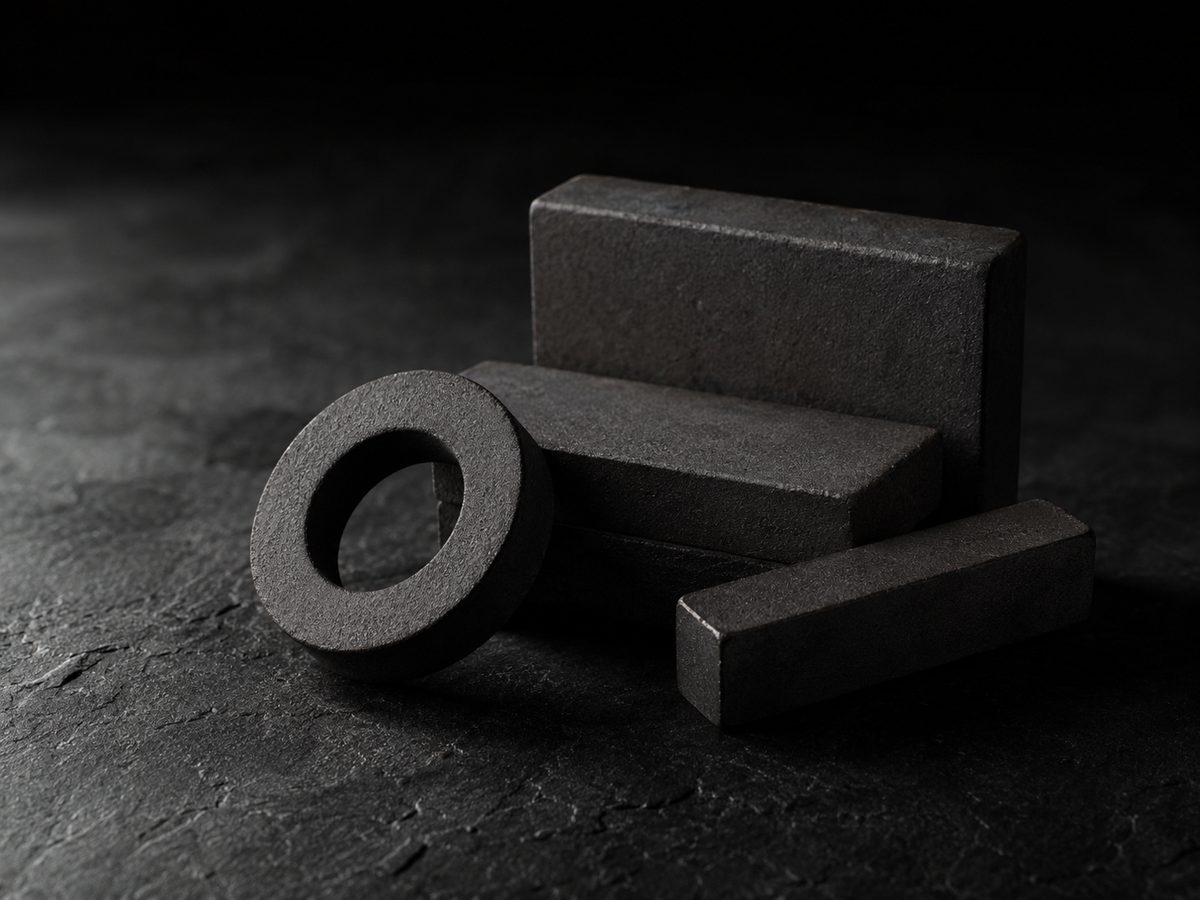
hard ferrite / ceramic
Ferrite (Ceramic) Magnets
Cheap flux, corrosion-proof, demagnetises in the cold
Sintered strontium or barium ferrite is an oxide ceramic magnet: BHmax of roughly 3.3-4.4 MGOe against roughly 33-53 MGOe for sintered NdFeB, but at a fraction of the cost per unit of flux and with no rare-earth price exposure. It corrodes essentially not at all — the material is already an oxide, so no plating is required — and its intrinsic coercivity is high for its price class and rises as it gets hotter. Choose it when you have volume to spare and cost, corrosion or supply stability dominate; avoid it where package size, mass, mechanical shock or sub-zero demagnetisation margin drive the design.
Request a quoteSpecification
- Grades
- Y30, Y30BH, Y33, Y35 (higher Br / BHmax); Y30H-1, Y30H-2, Y32H, Y33H (higher Hcj — the grades to reach for when cold-end demagnetisation is the constraint). All anisotropic, usually wet-pressed. Y8T / Y10T isotropic dry-pressed for low-cost or multipole work
- Remanence (Br)
- 0.38-0.44 T (3.8-4.4 kGs) for anisotropic grades; 0.20-0.24 T isotropic. Note the H grades trade Br down for Hcj
- Energy product (BHmax)
- 26-35 kJ/m3 (3.3-4.4 MGOe) anisotropic; 6.5-9.5 kJ/m3 (0.8-1.2 MGOe) isotropic — roughly one tenth of sintered NdFeB
- Intrinsic coercivity (Hcj)
- 175-260 kA/m (2.2-3.3 kOe) for standard grades; high-Hcj grades (Y30H-2, Y32H, Y34H, La-Co substituted automotive ferrite) reach ~290-320 kA/m (3.6-4.0 kOe). High relative to Br, which is what gives ferrite usable demagnetisation resistance at the price point
- Max operating temperature
- Up to about 250 degrees C without irreversible loss (Curie point ~450 degrees C) — but this is a stability limit, not a performance limit: at -0.20 %/K, Br at 250 C is roughly 45 % below its 20 degrees C value, so gap flux is nearly halved. The binding limit is usually the LOW end: below -20 to -40 degrees C, Hcj falls and irreversible loss becomes the risk
- Temperature coefficients
- Br: approx. -0.18 to -0.20 %/K (reversible). Hcj: approx. +0.2 to +0.5 %/K — positive, opposite in sign to NdFeB. Ferrite is magnetically strongest when cold and most demag-resistant when hot
- Tolerances
- As-sintered +/-2 % or +/-0.5 mm (whichever is greater); ground faces +/-0.05 to +/-0.1 mm typical, +/-0.02 mm achievable on small pole faces at added cost. Shrinkage 15-20 % from green, and anisotropic (differs parallel vs perpendicular to the alignment axis)
- Coatings, size range & magnetisation
- Normally supplied bare — no coating needed for corrosion; epoxy or paint only for cosmetics, sealing of the open porosity, or dust containment. Blocks, discs, rings and arc segments, ~5 mm to ~150 mm typical, larger arcs by tooling. Axial, radial or multipole; press-direction alignment fixes the easy axis at the tooling stage
Typical applications
- Loudspeaker and buzzer motors — one of the largest ferrite applications by tonnage; large ring or slug magnets where cost per unit of gap flux dominates and package volume is not constrained
- Automotive DC motors — window lifts, seat adjusters, blowers, wipers, washer pumps; arc segments bonded into a steel yoke, chosen for cost, corrosion tolerance and hot-end margin. Note the binding case here is the -40 degrees C cold start under stall or inrush armature reaction, not the hot end
- Magnetic separation — drum separators, grate magnets, plate magnets and pulleys in mining, aggregates, recycling and food processing, where large volumes of moderate field are needed and the magnet is cheap enough to treat as consumable
- Holding and latching — door catches, tool holders, whiteboard and signage magnets, cabinet latches; typically Y30 or Y25 in flat blocks and rings, or isotropic Y8T/Y10T where multipole patterning or lowest cost matters
- Sensors and reed-switch actuation — position, speed and proximity sensing where the magnet may sit in a wet or corrosive environment for years without coating
- Magnetic couplings and pump drives — chemical and food-grade pumps where direct exposure to process fluid rules out bare NdFeB; ferrite suits lower-torque duties, with NdFeB or SmCo taking the high-torque end
Engineering notes
- Ferrite has a positive Hcj temperature coefficient (approximately +0.2 to +0.5 %/K) but a negative Br coefficient (approximately -0.18 to -0.20 %/K). This inverts the NdFeB failure mode: ferrite is at greatest risk of irreversible demagnetisation when COLD, not hot. Below roughly -20 to -40 degrees C, Hcj can fall enough that a motor with an aggressive demagnetising field will lose flux permanently on a cold start. Design the low-temperature load line, not just the hot one — this catches a lot of engineers migrating a design from NdFeB. The corollary is that the 250 degrees C rating buys stability, not output: Br at 250 C is down roughly 45 %, so size the circuit on the hot Br and check the knee on the cold curve.
- Energy density is roughly one tenth of sintered NdFeB. Substituting ferrite for an N42 magnet at equal gap flux typically means 6-10 times the magnet volume and a heavier steel circuit. The magnet is cheaper per kilogram by an order of magnitude, but the assembly, yoke mass and machine size may not be — run the total cost of the magnetic circuit, not the cost per piece.
- It is a ceramic: hard, brittle, and with low and widely scattered tensile strength (tensile roughly 30-50 MPa, flexural / modulus of rupture typically 50-60 MPa, compressive 600-800 MPa, hardness around 480-580 HV). There is no plastic reserve and the strength scatter is Weibull-wide, so it must never be designed to a tensile allowable. It will chip on handling and crack under shock or clamping stress. Design for compressive loading only, allow generous edge chamfers, avoid thin sections below about 3 mm, and never treat the magnet as a structural member. Wire EDM does not work — hard ferrite is an electrical insulator, so all shaping is by diamond grinding.
- Dimensional tolerance as-sintered is poor. Shrinkage from the green compact runs 15-20 % and is anisotropic, so as-fired faces hold only about +/-2 % or +/-0.5 mm, whichever is greater. Any face that matters must be ground, and grinding is what drives the price. Specify tight tolerances only on the pole faces and locating datums — blanket +/-0.05 mm on all six faces of a block is a common and expensive RFQ mistake. Magnetic scatter is wider than NdFeB too: batch-to-batch Br variation of +/-3 to 5 % is normal, so if the application has a tight flux window, budget for 100 % flux sorting into bands.
- Corrosion resistance is genuinely excellent and rarely needs qualification: ferrite is already an oxide, so it does not rust, needs no Ni-Cu-Ni or epoxy coating, and survives long salt-spray exposure bare. The real caveats are three: strong acids attack it; the sintered body carries roughly 2-5 % open porosity, so it absorbs water and wicks process fluid, which matters in freeze-thaw immersion service where absorbed water can spall the surface; and any coating applied for cosmetic reasons adds cost without adding magnetic life. Specify sealing epoxy for immersion and freeze-thaw duty, not for corrosion.
Answers
Ferrite (Ceramic) Magnets FAQ
Can I just swap ferrite in where an NdFeB magnet is now, to cut cost?
Not as a drop-in. At the same geometry you will get roughly a third of the flux density, because Br is about 0.40 T against 1.30 T for a mid-grade NdFeB. To hold gap flux you need to grow the magnet volume by roughly 6-10 times and usually increase the pole area and the steel yoke with it. The swap makes commercial sense when the package has room and the machine is cost-driven — loudspeakers, separators, low-duty DC motors, holding devices. It rarely makes sense in a servo motor, a compact rotor, or anything where mass or envelope is a specification. The other reason to move is supply and price stability: ferrite is strontium carbonate and iron oxide, with no rare-earth exposure and none of the NdPr or dysprosium price volatility. The trap to watch is that the temperature failure mode inverts — an NdFeB design validated at the hot end has to be re-validated at the cold end.
Why does my ferrite magnet lose flux in winter but not in summer?
Because the temperature coefficients run opposite to NdFeB. Ferrite's intrinsic coercivity falls as it gets colder — around +0.2 to +0.5 %/K — so at -30 degrees C Hcj can be 15-25 % below its room-temperature value. If the operating point is already close to the knee, a cold start plus the armature's demagnetising field will push part of the magnet past the knee, and the loss is irreversible; it does not come back when the part warms up. The fix is either more magnet length in the direction of magnetisation to raise the permeance coefficient, or a genuinely higher-Hcj grade — that means an H-suffix grade such as Y30H-2, Y32H or Y33H, not Y33. Y33 is a high-Br grade with ordinary coercivity and will not help; if anything it tempts you into a more aggressive operating point. Plot the load line against the -40 degrees C demagnetisation curve, not the 20 degrees C one, and confirm which curve set the quotation is based on.
What should I actually put on the drawing to get a useful quote?
Six things. First, the grade or, better, the minimum Br and Hcj you need — grade names such as Y30 vary between suppliers, so a property window is unambiguous. Second, the operating temperature RANGE, and specifically the minimum temperature together with the worst-case demagnetising field at that temperature; for ferrite this is the case that sizes the magnet, and a quote built on 20 degrees C curves is worthless for a -40 degrees C application. Third, which faces are ground and to what tolerance, leaving the rest as-sintered; this is the single biggest cost lever. Fourth, the magnetisation direction and pole configuration, including any multipole pattern and pole count, since ring multipoles need dedicated fixturing. Fifth, whether parts ship magnetised or unmagnetised — unmagnetised handling and assembly is cheaper and safer, and magnetising in the yoke usually gives a better result. Sixth, the acceptance test: surface Gauss at a stated point with a stated probe, flux from a Helmholtz coil, or pull force. Chamfers and chip criteria are worth stating too, because a brittle oxide will always arrive with some edge condition and it is better to agree the limit up front.
Next