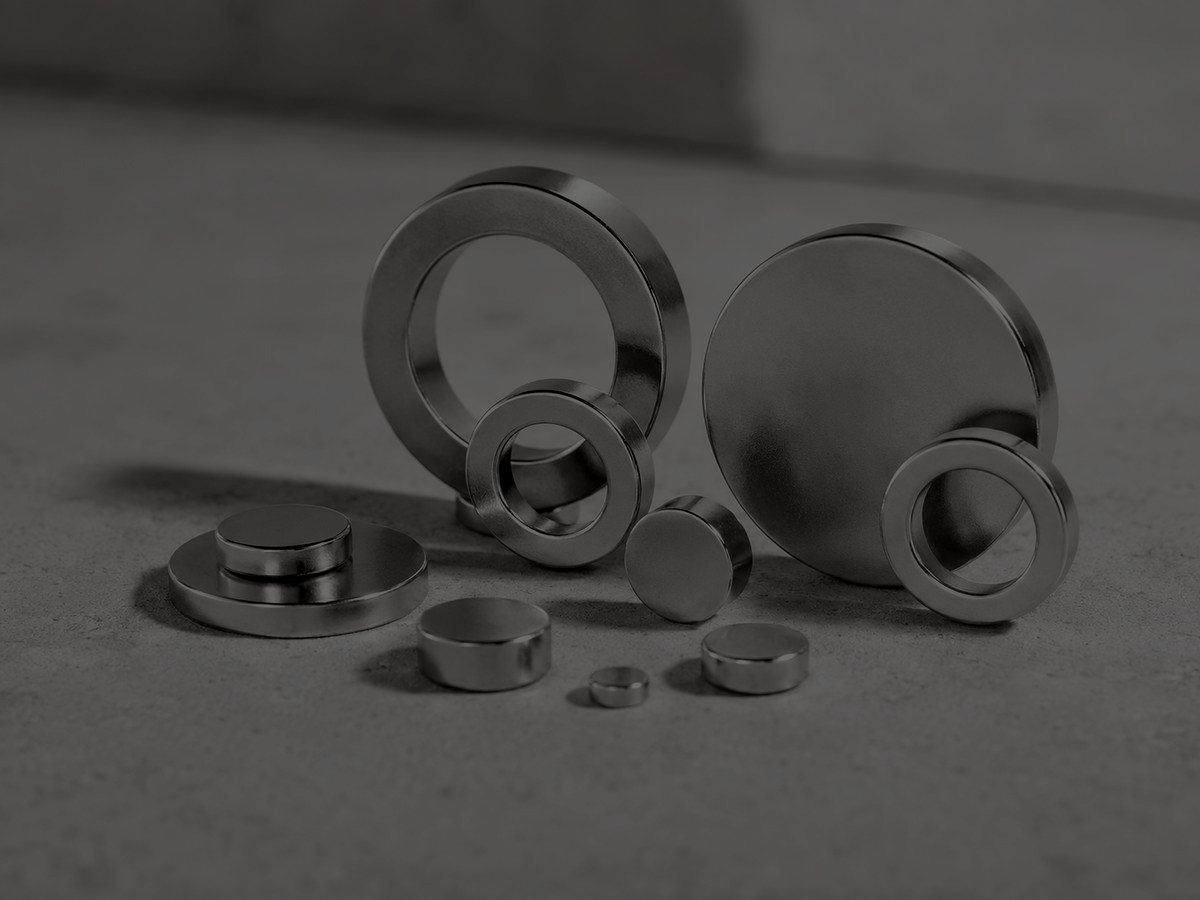
sintered NdFeB
Disc Magnets
Axially magnetised discs and rings, N35 to N52
Sintered NdFeB discs and rings are the default form factor when you need maximum flux from a compact axial gap — sensor targets, holding pads, loudspeaker and voice-coil assemblies, rotor pole pieces. The disc geometry is press-friendly and cheap to tool, so lead time and unit cost are usually better than for arcs or complex profiles at the same grade. Choose a disc when the working gap is along the thickness axis and the permeance coefficient is high enough (typically L/D above roughly 0.5) that the magnet is not driven into irreversible demagnetisation at temperature.
Request a quoteSpecification
- Grade range
- N35 to N52 (N series); M, H, SH, UH, EH variants where temperature demands it
- BHmax
- 263–287 kJ/m³ (33–36 MGOe) for N35; 398–422 kJ/m³ (50–53 MGOe) for N52
- Remanence (Br)
- 1.17–1.22 T (N35) up to 1.43–1.48 T (N52)
- Intrinsic coercivity (Hcj)
- ≥955 kA/m (12 kOe) for mid N-series grades, falling to ≥876 kA/m (11 kOe) at N50/N52; ≥1592 kA/m (20 kOe) for SH; ≥2388 kA/m (30 kOe) for EH
- Max operating temperature
- 60–80 °C (N50/N52, and only at a healthy permeance coefficient) to 200 °C (EH grades) — geometry-dependent, not a material constant
- Dimensional tolerance
- ±0.05 mm ground surfaces standard; ±0.1–0.2 mm (or ±2–3%, whichever is greater) as-sintered/tumbled; ±0.02 mm achievable on critical ground faces at added cost
- Coatings
- NiCuNi (standard), Zn, black epoxy, NiCuNi+epoxy, Parylene, Everlube; passivation for vacuum work. Sintered NdFeB always needs a coating — there is no bare option for service use.
- Size range
- Ø1 mm to Ø100+ mm discs; rings with ID from ~2 mm; thickness 0.5 mm to 40 mm typical
Typical applications
- Rotary position and speed sensing — diametrically or axially magnetised ring targets over Hall/AMR/TMR ICs
- Loudspeaker and micro-speaker motors, voice-coil actuators, haptic linear resonant actuators
- Magnetic couplings and clutches using axially magnetised disc arrays across a barrier wall
- Holding and latching — cabinet catches, fixtures, tool holders, medical and lab equipment closures
- BLDC rotor pole pieces in surface-mount and axial-flux motor topologies (arc segments are more common on radial-flux surface-mount rotors above small diameters)
- Separation and filtration assemblies where discs are stacked into rods or grates
Engineering notes
- Grade and temperature are coupled through geometry, not independent. A thin N52 disc (L/D ≈ 0.2) sits at a low permeance coefficient and can lose flux irreversibly well below its 60–80 °C nominal ceiling, while the same alloy at L/D ≈ 1.0 is comfortable. Specify the operating point, not just a grade — send us the gap, the back-iron, and the worst-case ambient and we will run the load line rather than guess.
- The high-BHmax grades buy energy density by trading away coercivity. N52 is typically specified at Hcj ≥876 kA/m (11 kOe) against ≥1592 kA/m (20 kOe) for an SH grade — a little over half. If your application sees back-EMF from a coil, a nearby opposing magnet, or an assembly fixture with a stray field, the headline BHmax is the wrong thing to optimise for.
- Sintered NdFeB is brittle — flexural strength around 250–350 MPa, essentially zero ductility, and it will chip at edges under impact or if two magnets are allowed to snap together. It is a sintered intermetallic, not a ceramic ferrite, and it behaves differently: harder, denser, far more corrosion-prone. Chamfers help; press-fits with interference above ~0.02 mm generally do not. Design for adhesive bonding or mechanical capture, not for the magnet as a structural member.
- Corrosion is the dominant field failure. Bare NdFeB oxidises and swells; NiCuNi is fine for indoor and sealed use but is not a marine or automotive underbody coating on its own. Salt-spray expectations: roughly 24–72 h for NiCuNi (sharp disc edges sit at the low end, where plating coverage is thinnest), 500+ h for epoxy over nickel. Coating adds roughly 15–30 µm per surface and must be in your tolerance stack.
- Rings and thin discs magnetised axially have significant flux leakage around the OD, so measured pull force on a real assembly is routinely 30–50% below an idealised calculation. Prototype and measure before committing to a production tolerance on force.
Magnetic properties
Sintered NdFeB grade data
Measured at 20 °C. Every shipment leaves with a hysteresigraph report against these figures — ask for the lot data, not a datasheet reprint.
| Grade | Br (T) | Hcb (kA/m) | Hcj (kA/m) | BHmax (kJ/m³) | BHmax (MGOe) | Max op. temp. |
|---|---|---|---|---|---|---|
| N35 | 1.17–1.22 | ≥ 868 | ≥ 955 | 263–287 | 33–36 | 80 °C |
| N38 | 1.22–1.25 | ≥ 899 | ≥ 955 | 287–310 | 36–39 | 80 °C |
| N42 | 1.28–1.32 | ≥ 923 | ≥ 955 | 318–342 | 40–43 | 80 °C |
| N45 | 1.32–1.38 | ≥ 923 | ≥ 955 | 342–366 | 43–46 | 80 °C |
| N48 | 1.38–1.42 | ≥ 923 | ≥ 876 | 366–390 | 46–49 | 80 °C |
| N52 | 1.43–1.48 | ≥ 876 | ≥ 876 | 398–422 | 50–53 | 80 °C |
| N42M | 1.28–1.32 | ≥ 963 | ≥ 1114 | 318–342 | 40–43 | 100 °C |
| N42H | 1.28–1.32 | ≥ 963 | ≥ 1353 | 318–342 | 40–43 | 120 °C |
| N42SH | 1.28–1.32 | ≥ 979 | ≥ 1592 | 318–342 | 40–43 | 150 °C |
| N38UH | 1.22–1.25 | ≥ 923 | ≥ 1990 | 287–310 | 36–39 | 180 °C |
| N35EH | 1.17–1.22 | ≥ 876 | ≥ 2388 | 263–287 | 33–36 | 200 °C |
Read the suffix, not just the number. None / M / H / SH / UH / EH denote intrinsic coercivity class — higher classes hold their magnetism hotter, at the cost of remanence and heavy rare earth (Dy/Tb). Max operating temperatures assume a permeance coefficient near 2: a thin magnet, or one facing an opposing coil field, will lose output well below the figure quoted. Figures are typical production ranges, not guaranteed minima for every lot.
Answers
Disc Magnets FAQ
Should I specify N52 to get the strongest disc?
Usually not by default. N52 gives roughly 10–13% more remanence than N42 (1.43–1.48 T vs 1.28–1.32 T) — the larger-sounding gap is in energy product, not field — and it comes with markedly lower intrinsic coercivity, a lower practical temperature ceiling, and a higher price per piece. If your design has thermal headroom and no opposing field, N52 is a legitimate choice. If it runs warm, sees a coil, or has a low permeance coefficient, an N42SH will often deliver more usable flux in service than an N52 that has partially demagnetised. Tell us the operating conditions and we will compare the two on the load line.
Can you supply diametrically magnetised discs and rings, or multipole?
Yes. Axial is the standard and cheapest orientation because it follows the press direction. Diametric magnetisation on a disc requires the alignment field to be applied transverse to pressing, which restricts the aspect ratios we can hold and typically adds cost and lead time. Multipole ring magnetisation is done post-sinter with a dedicated fixture — practical, but the fixture is tooling you pay for once. Send the pole count, angular tolerance and the sensor part number.
What do you need from me to quote a disc?
Outer diameter, inner diameter if a ring, thickness, and which of those is critical. Then: grade or — better — the operating temperature range, the working gap and any back-iron, magnetisation direction, coating, annual volume, and whether the part is magnetised before or after assembly. Shipping magnetised parts adds dangerous-goods handling; many customers assemble unmagnetised and magnetise in-house, which is worth discussing early.
Next