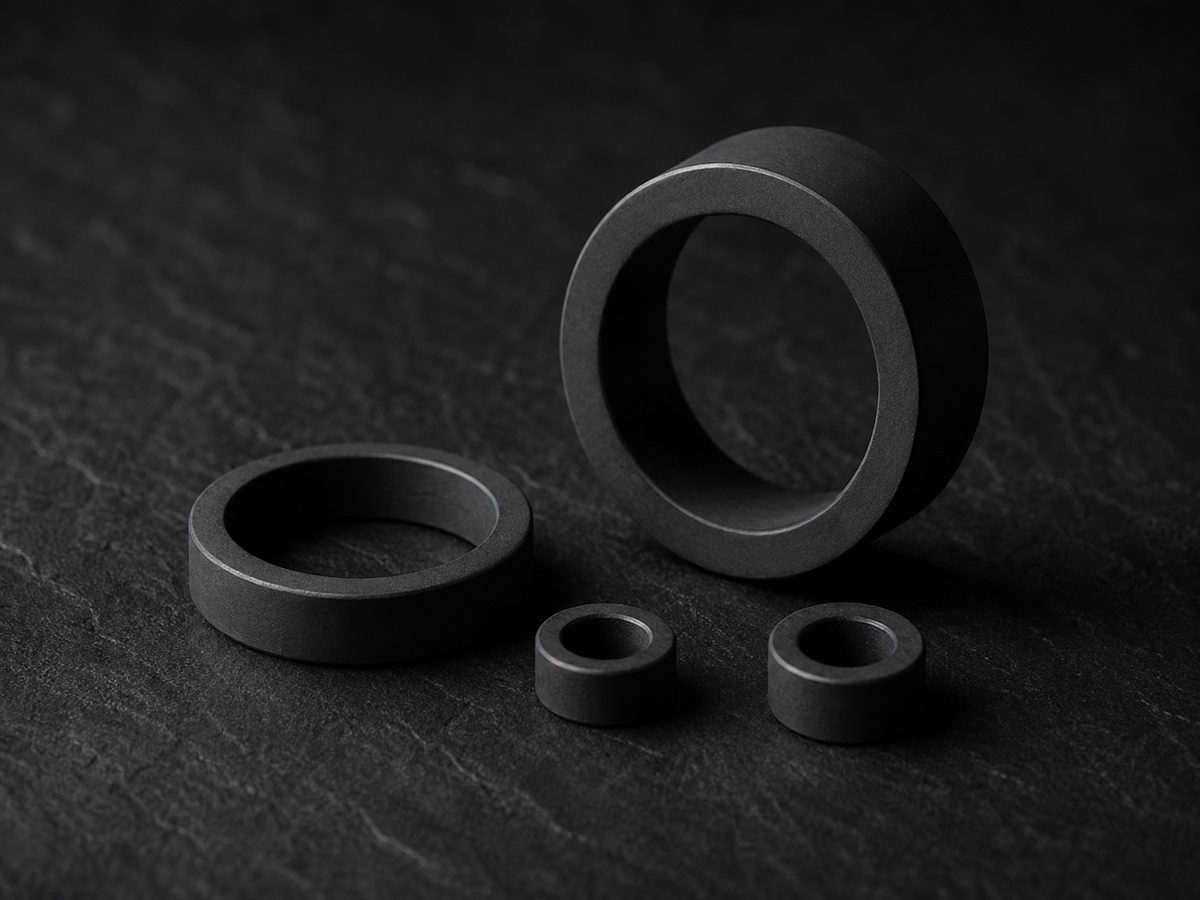
bonded NdFeB
Bonded NdFeB
Net-shape NdFeB where geometry beats energy product
Bonded NdFeB is isotropic rapidly-quenched (melt-spun) NdFeB powder held in an epoxy (compression moulded) or polyamide/PPS (injection moulded) binder, typically 75-80 vol% magnetic loading compression and 60-65 vol% injection. BHmax lands around 4-12 MGOe — roughly a seventh to a third of sintered — because the binder is dead volume and isotropic powder gives no crystallographic texture. Choose it when the part is thin-walled, multipole, dimensionally tight, or an awkward shape that sintering would only reach through expensive grinding: rings with 8-24 poles moulded in one shot, wall sections near 1 mm, ±0.05-0.1 mm as-moulded, and no coating strictly required in benign, dry environments.
Request a quoteSpecification
- BHmax range
- 7-11 MGOe compression moulded (56-88 kJ/m³); 4-7 MGOe injection moulded (32-56 kJ/m³). Anisotropic bonded grades (HDDR or hot-deformed powder aligned in a field during moulding) reach roughly 15-23 MGOe, at higher powder cost and with an aligning tool.
- Remanence (Br)
- 0.55-0.72 T compression; 0.40-0.60 T injection. Isotropic — magnetisable in any direction, but with no easy axis to exploit. For isotropic material BHmax ≈ Br²/4μ₀, so Br sets the energy product directly.
- Intrinsic coercivity (Hcj)
- 640-1000 kA/m (8-12.5 kOe). Melt-spun powder is inherently high-Hcj because of its nanocrystalline grain structure — demagnetisation resistance is rarely the limiting factor.
- Max operating temperature
- Binder-limited, not magnet-limited: 120-150 °C epoxy (compression); 120-150 °C polyamide (PA11/PA12 injection); 150-200 °C PPS (injection). Nylon-bound injection grades do not run hotter than epoxy compression grades — PPS is the high-temperature option. Above the binder limit the polymer softens, creeps or degrades before the NdFeB does.
- Temperature coefficients
- α(Br) ≈ -0.10 to -0.13 %/°C; β(Hcj) ≈ -0.40 %/°C. Reversible loss is comparable to sintered; irreversible loss is usually a binder, creep or powder-oxidation story rather than a coercivity story.
- As-moulded tolerance
- ±0.05 mm on injection-moulded features; ±0.05-0.1 mm typical compression, ±0.1 mm on larger dimensions — achievable without grinding. Ground sintered faces hold ±0.02-0.05 mm, so tolerance alone is not the argument: it is holding a usable tolerance on a net-shape multipole geometry in one operation.
- Size and wall section
- Rings, arcs, discs and cups from roughly 3 mm to 80 mm OD. Wall down to ~1 mm compression, ~0.6 mm injection. Insert-moulding onto shafts and hubs is routine.
- Coating and density
- Epoxy spray/e-coat, impregnation or parylene for compression grades; injection-moulded parts often run bare in dry service. Density 4.2-5.0 g/cm³ injection and ~5.8-6.2 g/cm³ compression, against 7.4-7.6 for sintered. The polymer isolates each particle and removes the continuous Nd-rich grain-boundary network that lets sintered NdFeB corrode intergranularly — but bonded parts retain residual porosity, take up moisture, and surface-exposed particles still oxidise. Coat for humid or salt-laden service.
Typical applications
- BLDC and stepper rotors for pumps, fans and HVAC actuators — thin multipole rings insert-moulded straight onto the shaft, removing a separate bond-and-balance operation
- Position and speed sensor rings for encoders, ABS wheel sensors and steering-angle sensors, where pole-pitch uniformity matters far more than peak flux density
- Small precision motors in office automation, HDD spindle and camera focus mechanisms, where thin walls and tight as-moulded tolerances rule out ground sintered parts
- Multipole couplings and small magnetic gears in dosing and metering equipment, where the moulded polymer skin tolerates chemical exposure that would attack the coating on a plated sintered magnet — note that torque-dense pump couplings usually still go sintered
- Complex-geometry parts — cups, arcs with integral features, over-moulded assemblies — where sintering plus grinding costs more than the energy product is worth
- Consumer and appliance actuators, latches and small linear motors that need multipole patterning at low piece price rather than maximum torque density
Engineering notes
- The energy product penalty is real and unavoidable. At 8 MGOe against an N42 sintered part you need roughly 5x the magnet volume for the same stored airgap energy; for the same airgap flux the multiplier is set by the load line and the Br ratio (about 2x on Br alone), so run the magnetic circuit rather than scaling a single number. If the envelope is tight and the geometry is simple, sintered wins on cost per unit of flux — bonded only pays when the shape or the pole count is doing work for you.
- The binder sets the thermal ceiling, and it fails differently from a magnet. Sintered NdFeB above its limit loses flux irreversibly but stays a solid part; a bonded magnet above its binder limit can creep, swell or crack, and an insert-moulded rotor can lose its grip on the shaft. Qualify at the real hot-spot temperature, not the nominal ambient — and check which binder you are actually being quoted, since PA12 and PPS are 50 °C apart.
- Mechanical strength is modest. Flexural strength runs roughly 40-80 MPa depending on binder and loading, against ~250 MPa transverse rupture strength for sintered. Bonded parts tolerate handling and light press-fits better than sintered (they do not chip), but they will not carry structural load, and high-speed rotors usually still need a retaining sleeve or a designed-in hub.
- Tooling is a real up-front cost and a real lead time. Compression tools are cheaper; injection tools for multipole rings are not, and neither is the magnetising fixture. Anisotropic bonded grades need an alignment field in the tool, which raises the tooling cost again. Below a few thousand pieces a year the amortised tooling often erases the savings from skipping grinding — run the numbers before committing.
- Long-term moisture uptake is the quiet failure mode. The polymer removes the intergranular corrosion path but is not a moisture barrier, and the part is not fully dense; nylon binders in particular absorb water, which swells the part and slowly oxidises exposed particles. For humid, salt-spray or automotive underbonnet service, specify a coating and ask for 85 °C/85% RH data rather than assuming the binder handles it.
Answers
Bonded NdFeB FAQ
Why is BHmax so much lower than sintered NdFeB?
Two independent losses stack. First, dilution: 20-40 vol% of the part is non-magnetic binder, and BHmax scales roughly with the square of the magnetic volume fraction. Second, isotropy: the melt-spun powder has randomly oriented nanograins, so remanence is capped near half the saturation value rather than the ~95% alignment achieved in a pressed-in-field sintered magnet. Multiply it through — about 0.28 for isotropy, about 0.5 for dilution at 70 vol% loading — and a 42 MGOe sintered composition lands around 6 MGOe, or up to 10-11 MGOe at the ~80 vol% loading a compression tool can reach. Anisotropic bonded powder recovers most of the isotropy loss and gets you to 15-23 MGOe, at a price.
Do bonded magnets need a protective coating?
Often not, and that is a genuine advantage. Sintered NdFeB corrodes along Nd-rich grain boundaries and will powder away without a barrier coating; in bonded material the polymer isolates each particle, so there is no continuous corrosion path. For indoor, dry or oil-wetted service, bare injection-moulded parts are common. For humidity, salt spray or automotive underbonnet, specify epoxy spray/e-coat, impregnation or parylene — the polymer is not a moisture barrier, the part retains some porosity, and prolonged damp will still cause slow flux loss through oxidation of exposed particles. Note that electroplated nickel, standard on sintered NdFeB, is not a normal option here: you cannot plate a porous polymer surface soundly.
When should I send an RFQ for bonded rather than sintered?
Send it when at least one of these is true: you need more than about six poles on a single ring, your wall section is under ~2 mm, you need as-moulded tolerances without a grinding operation, the geometry has features that sintering cannot form, or your environment would demand an expensive coating scheme on a sintered part. If none apply and you simply want flux in a box, quote sintered instead. Bring your working temperature, pole count, pole pattern, airgap flux target and annual volume — volume drives the tooling decision more than anything else.
Next